If you’ve ever stared at a professional dehumidifier wondering whether to flip on the humidistat or just let it run — you’re not alone. It’s one of the most common questions we get at GreenFox Air Quality, and the answer depends entirely on what you’re trying to accomplish: are you drying a structure after water damage, or are you maintaining healthy ambient air quality long-term?
At GreenFox Air Quality, we use both settings regularly. Here’s how to know which one your situation calls for.
What’s the Difference?
A dehumidifier has two basic operating modes:
Constant Run means the machine runs continuously, regardless of what the air’s relative humidity (RH) reads. It pulls moisture non-stop until you turn it off.
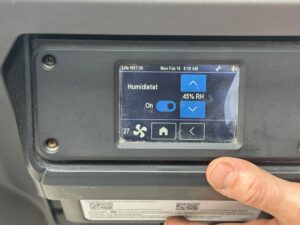
Humidistat Mode means the machine targets a set RH level — say, 45% — and cycles on and off to maintain it. Once the air hits that number, it stops.
Both are useful. But using the wrong one at the wrong time can cost you — either in ongoing moisture damage or in dried-out, uncomfortable air.
When to Use Constant Run (Humidistat Off)
Use constant run any time you’re dealing with structural drying — water damage, flooding, a burst pipe, or a wet crawl space after heavy rain.
Here’s why: when building materials like drywall, subfloor, wood framing, or concrete absorb water, the moisture lives inside the material — not in the air. Your humidistat reads ambient air humidity. It doesn’t know your subfloor is sitting at 20% moisture content.
If you set a humidity target and the room air reaches 50% RH, the machine shuts off — even if your walls are still soaking wet. That’s a problem.
Constant run keeps the machine working until the job is finished. Track your progress with a moisture meter, not a hygrometer.
A few things to keep in mind with constant run:
- Pair it with air movers to maximize evaporation off wet surfaces
- The EPA notes mold can begin developing within 24–48 hours on wet porous materials — speed matters
- Check moisture readings daily in affected materials to track actual drying progress
When to Use Humidistat Mode (40–50% RH)
Once structural drying is complete — or if you’re simply maintaining air quality in an occupied space — this is where humidistat mode earns its keep.
ASHRAE Standard 62.1 (Ventilation for Acceptable Indoor Air Quality) recommends keeping indoor relative humidity between 30–60%, with 40–50% RH being the widely accepted sweet spot for health and comfort. The EPA’s indoor air quality guidance aligns with this range.
Why does that range matter? Research published in Environmental Health Perspectives found that 40–60% RH minimizes the simultaneous risks of mold growth, dust mite proliferation, bacterial survival, and respiratory irritation. Too dry (below 30%) and you irritate mucous membranes. Too humid (above 60%) and you’re feeding biological contaminants.
For South Florida specifically — where outdoor humidity regularly hits 75–85% — an unconditioned or under-ventilated space will trend toward those dangerous upper levels fast. Humidistat mode set to 45–50% RH keeps ambient air in the healthy zone without over-drying.
Practical settings guide:
- 40% RH — Use when mold risk is elevated or post-remediation
- 45% RH — Ideal year-round maintenance for most occupied Florida spaces
- 50% RH — Upper comfort range; fine for most climates, watch it in high-humidity regions
The Key Distinction — And the Mistake Most People Make
The most common mistake we see: someone sets their dehumidifier to 50% RH after a water loss, the room “feels dry,” and they assume the job is done.
It’s not.
Ambient air can reach target humidity levels while building materials remain dangerously wet. That false reading delays drying, invites mold, and can lead to much more expensive remediation down the road.
Rule of thumb:
- Water damage or structural drying? → Constant run. Humidistat off. Measure materials.
- Healthy space maintenance? → Humidistat on. Set 40–50% RH. Let it cycle.
The Bottom Line
Your dehumidifier is only as effective as its settings. Constant run is an aggressive drying tool — built for situations where speed and thoroughness matter above all else. Humidistat mode is a precision maintenance tool — built to keep occupied spaces healthy and comfortable over time.
Understanding the difference isn’t just good HVAC knowledge. In South Florida’s climate, it’s the difference between a dry home and a mold problem.
GreenFox Air Quality
We serve South Florida with professional dehumidification, moisture assessment, and indoor air quality services. Have questions about your space? Reach out to us!