
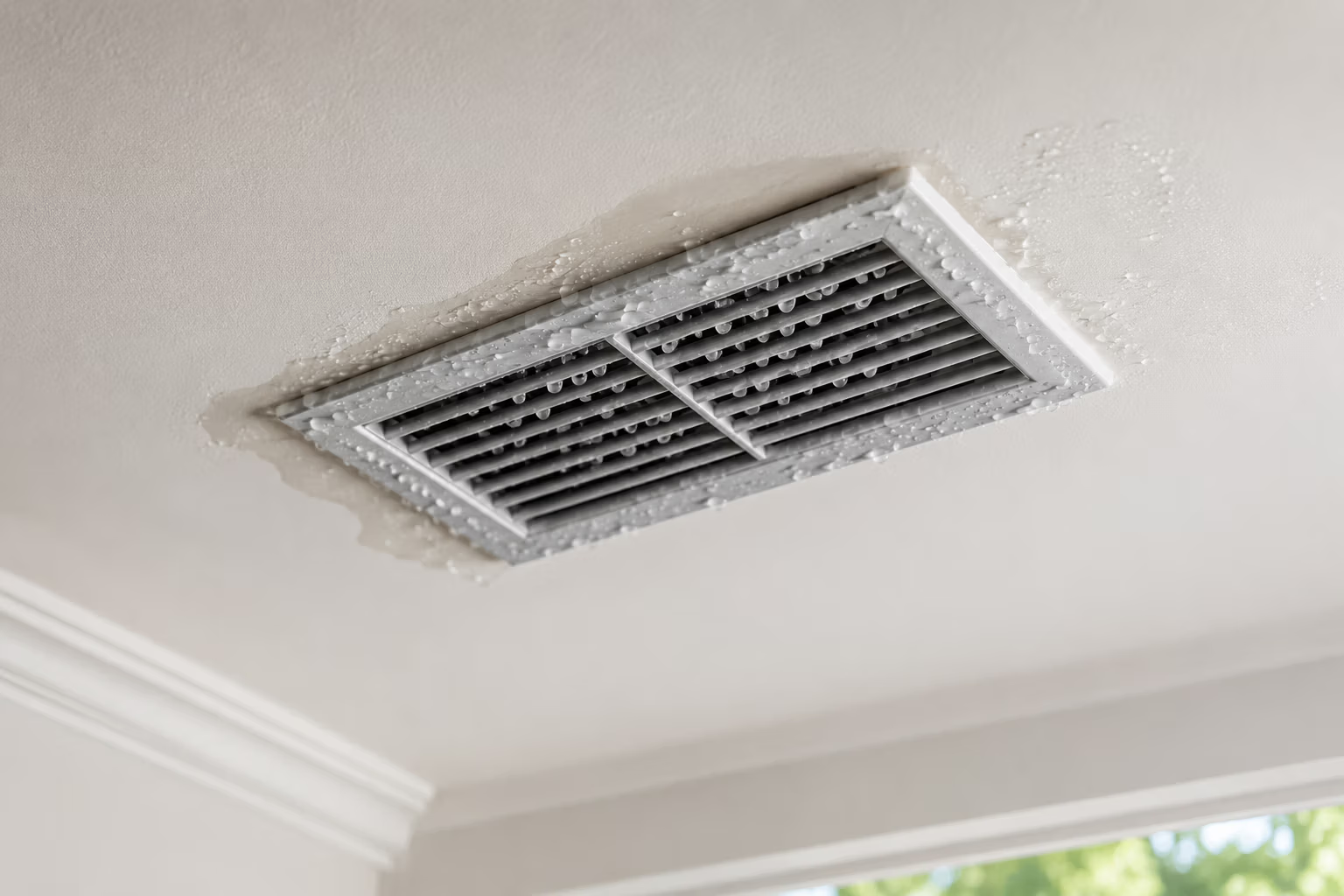
Sweating Vents: Why Condensation Forms on Supply Registers in Florida Homes
If you notice water droplets forming around your air-conditioning vents, you may be dealing with what HVAC professionals call “sweating vents.” This is especially common in Florida, where high outdoor humidity, hot attic temperatures, and continuously operating air-conditioning systems create ideal conditions for condensation.
Although a small amount of moisture may seem harmless, sweating supply registers should not be ignored. Persistent condensation can stain ceilings, damage drywall, create musty odors, and contribute to microbial growth around the vent or inside the surrounding ductwork.
What Causes an AC Vent to Sweat?
Condensation forms when warm, humid air contacts a surface that is colder than the air’s dew point. Your air-conditioning system sends cold air through the ductwork and supply registers. If humid air reaches the cold metal register, water vapor can turn into liquid droplets—similar to moisture forming on the outside of a cold glass.
In Florida homes, several conditions can make this problem worse.
High Indoor Humidity
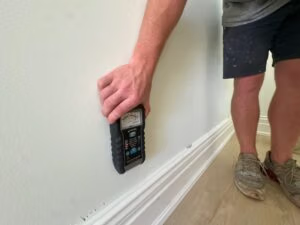
High indoor humidity is one of the most common causes of sweating vents. Ideally, indoor relative humidity should generally remain between 30% and 60%, with many Florida homes feeling most comfortable around 45% to 55%.
Humidity can increase because of:
- Frequent opening of exterior doors and windows
- Air leaks around doors, windows, and ceiling penetrations
- Plumbing or roof leaks
- An oversized air-conditioning system that cools too quickly
- Improper thermostat fan settings
- Insufficient dehumidification
- Humid air entering from an attic, garage, or crawl space
When the air surrounding a supply register contains too much moisture, condensation is more likely to form.
Air Leaks Around the Register Boot
The supply register is attached to a metal or fiberglass box known as a register boot. If the boot is not properly sealed to the ceiling or duct connection, hot and humid attic air can leak into the area surrounding the vent.
When this humid attic air meets the cold register, condensation develops. Dark staining or microbial growth around the vent may indicate an air leak rather than a dirty register alone.
Simply wiping or painting over the affected area will not correct the underlying problem. The gaps around the boot and duct connection must be properly inspected and sealed.
Damaged or Missing Duct Insulation
Florida attics can become extremely hot and humid. Ductwork installed in these spaces must be properly insulated to prevent the cold air inside the duct from cooling its exterior surface below the dew point.
Condensation may develop when insulation is:
- Missing or improperly installed
- Compressed or deteriorated
- Saturated from previous moisture exposure
- Separated from the register boot
- Damaged by pests or attic work
Wet duct insulation can lose some of its insulating effectiveness, allowing the problem to continue or worsen.
Airflow Problems
Restricted airflow can cause supply air and nearby HVAC components to become excessively cold. This increases the temperature difference between the register and the surrounding air, making condensation more likely.
Common airflow restrictions include:
- Dirty air filters
- Blocked or closed supply registers
- Dirty evaporator coils
- Improperly sized ductwork
- Crushed, sagging, or disconnected flexible ducts
- Blower motor or fan-speed problems
Incorrectly Sized Air-Conditioning Equipment
A system that is too large for the home may cool the space quickly but shut off before it has enough time to remove sufficient moisture from the air. This is known as short cycling.
The thermostat may show a comfortable temperature while indoor humidity remains elevated. The combination of cold supply registers and humid indoor air can then lead to sweating vents, stuffiness, and inconsistent comfort.
Proper equipment sizing is particularly important in South
Florida, where moisture removal is just as important as temperature control.
Thermostat Fan Settings
Leaving the thermostat fan set to “ON” can sometimes contribute to indoor humidity problems. After the cooling cycle ends, the blower may continue moving air across a wet evaporator coil, allowing some of that moisture to re-enter the home.
For many systems, setting the fan to “AUTO” helps the blower shut off when the cooling cycle ends. However, every HVAC system is different, so recurring humidity concerns should be professionally evaluated.
Can Sweating Vents Cause Mold?
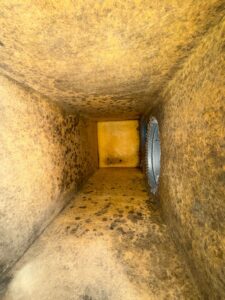
Persistent condensation can create conditions that support microbial growth. Moisture may collect on the register, ceiling, drywall, insulation, or inside the register boot. Over time, you may notice:
- Dark spotting around the vent
- Peeling or bubbling paint
- Water stains
- Soft or damaged drywall
- Rust on metal registers
- Musty odors
- Visible growth inside the boot or ductwork
Discoloration around a vent should be evaluated carefully. Not every dark mark is mold, and laboratory testing may be necessary when confirmation is required. However, the source of the moisture should always be corrected.
How Are Sweating Vents Corrected?
The proper solution depends on the cause. Professional corrective work may include:
- Measuring indoor temperature and relative humidity
- Inspecting supply registers and register boots
- Sealing gaps between boots and ceiling openings
- Repairing leaking duct connections
- Replacing damaged or saturated insulation
- Correcting crushed, disconnected, or undersized ducts
- Cleaning dirty coils, blower components, or filters
- Evaluating equipment sizing and system runtime
- Adjusting airflow or thermostat settings
- Installing a whole-home dehumidifier when necessary
- Cleaning and treating affected surfaces after the moisture source is corrected
Replacing the vent cover alone rarely solves a recurring condensation problem.
Don’t Ignore Condensation Around Your Vents
Sweating supply registers are often an early warning sign of excessive humidity, duct leakage, damaged insulation, or an HVAC performance issue. Addressing the problem early can help prevent ceiling damage, unpleasant odors, indoor air-quality concerns, and more expensive repairs.
Greenfox Air Quality provides detailed HVAC and indoor air-quality inspections throughout South Florida. Our team can inspect your ductwork, register boots, insulation, airflow, and humidity levels to identify why condensation is forming and recommend the appropriate solution.
If your vents are sweating, staining the ceiling, or developing a musty odor, contact Greenfox Air Quality to schedule an inspection.
Air Quality Done the Greenfox Way.
