
What Are the New Refrigerants? Understanding R-32 and R-454B
If you are shop
ping for a new air-conditioning system, you may hear unfamiliar terms such as R-32, R-454B, A2L refrigerant, or low-GWP equipment. These refrigerants are becoming increasingly common as the HVAC industry moves away from R-410A in newly manufactured residential and light-commercial systems.
Although refrigerants are often casually called “Freon,” Freon is technically a brand name. Refrigerant is the proper general term for the substance that circulates through an air-conditioning system and transfers heat from inside the property to the outdoors.
So, what exactly are R-32 and R-454B, why is the industry changing, and what does this mean for South Florida homeowners?
Why Is R-410A Being Replaced?
For many years, R-410A was the primary refrigerant used in residential air-conditioning systems. It replaced R-22 because R-22 contributed to ozone depletion.
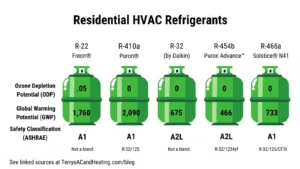
R-410A does not damage the ozone layer, but it has a relatively high Global Warming Potential, commonly called GWP. GWP measures how strongly a gas can contribute to global warming if released into the atmosphere.
The U.S. Environmental Protection Agency has established restrictions intended to transition newly manufactured residential and light-commercial HVAC equipment toward refrigerants with a GWP below 700. The broader goal of the American Innovation and Manufacturing Act is to reduce the production and consumption of regulated hydrofluorocarbon refrigerants by 85% from historical baseline levels by 2036. U.S. Environmental Protection Agency
This transition does not mean that every existing R-410A system must immediately be replaced. R-410A systems can continue to operate and be serviced. The changes primarily affect the manufacture of new equipment and the long-term availability and cost of higher-GWP refrigerants.
What Is R-32 Refrigerant?
R-32, also known as difluoromethane, is a single-component refrigerant being used in many new air conditioners, heat pumps, and ductless mini-split systems.
R-32 has a GWP of approximately 675, compared with a GWP of more than 2,000 for R-410A. This means R-32 has roughly one-third of the global warming impact of R-410A if the same amount is released into the atmosphere.
R-410A itself is a blend containing 50% R-32. Using R-32 by itself eliminates the need for the second component of the R-410A mixture and can provide efficient heat-transfer performance.
Benefits of R-32
R-32 offers several potential advantages:
- Significantly lower GWP than R-410A
- Zero ozone-depletion potential
- Strong heat-transfer performance
- Potentially smaller refrigerant charges in properly designed systems
- Single-component composition, which can simplify refrigerant recovery and recycling
- Increasing availability in new residential and ductless HVAC equipment
The actual efficiency of an air-conditioning system still depends on its complete design, including the compressor, coil, metering device, blower, duct system, installation quality, and airflow. Refrigerant alone does not determine how efficient or reliable a system will be.
What Is R-454B Refrigerant?
R-454B is another lower-GWP refrigerant selected by several major HVAC manufacturers as a replacement for R-410A.
Unlike R-32, R-454B is a refrigerant blend. It is composed of approximately 68.9% R-32 and 31.1% R-1234yf. According to ASHRAE’s refrigerant classification information, it carries an A2L safety classification. ASHRAE Standard 34 refrigerant data
R-454B has a GWP of approximately 466, making its direct global warming impact substantially lower than that of R-410A. Carrier markets R-454B under the name Puron Advance and reports a GWP reduction of approximately 75% compared with R-410A. Carrier R-454B information
Benefits of R-454B
R-454B offers:
- A lower GWP than both R-410A and R-32
- Zero ozone-depletion potential
- Operating characteristics suitable for modern residential and light-commercial equipment
- Performance designed to remain relatively close to R-410A in compatible systems
- Compliance with current lower-GWP refrigerant requirements
R-454B is a mildly zeotropic blend, meaning its components can change phase at slightly different temperatures. Technicians must follow the manufacturer’s procedures when charging and servicing equipment.
R-32 vs. R-454B
| Feature | R-32 | R-454B |
|---|---|---|
| Refrigerant type | Single component | Two-component blend |
| Approximate GWP | 675 | 466 |
| Ozone-depletion potential | Zero | Zero |
| Safety classification | A2L | A2L |
| Common applications | Central AC, heat pumps and mini-splits | Central AC and heat pumps |
| Can it replace R-410A in an existing system? | No | No |
Both refrigerants satisfy the EPA’s GWP limit for newly manufactured residential and light-commercial air-conditioning equipment. The choice between them is generally made by the equipment manufacturer rather than the homeowner or contractor.
One refrigerant is not automatically better in every application. The quality of the equipment, proper system sizing, correct installation, available replacement parts, manufacturer support, efficiency ratings, warranty coverage, and the contractor’s experience are all more important than selecting a system based exclusively on its refrigerant.
Are R-32 and R-454B Flammable?
R-32 and R-454B are classified as A2L refrigerants.
The “A” indicates lower toxicity under the applicable refrigerant safety classification. The “2L” indicates that the refrigerant has lower flammability and a relatively slow burning velocity.
A2L refrigerants are often described as mildly flammable. They are not handled in exactly the same way as older A1 refrigerants such as R-410A. New A2L systems may include refrigerant detection, airflow or mitigation controls, updated electrical components, specialized fittings, and specific installation requirements.
Homeowners should not attempt to open, charge, recover, or repair a refrigerant circuit. A2L equipment should be installed and serviced by trained HVAC technicians using approved tools, recovery equipment, procedures, and safety practices.
Can R-32 or R-454B Be Added to an Existing R-410A System?
No. R-32 and R-454B are not drop-in replacements for R-410A.
An air-conditioning system is engineered for a specific refrigerant, pressure range, compressor oil, metering device, coil design, refrigerant charge, electrical configuration, and safety system. Mixing refrigerants or placing a different refrigerant into equipment that was not designed for it can damage the system, create a safety hazard, void the manufacturer’s warranty, and violate applicable regulations.
The indoor and outdoor equipment must also be properly matched. An R-410A air handler should not be combined with an R-32 or R-454B condenser unless the manufacturer has specifically designed, tested, and approved that exact equipment combination.
Do You Need to Replace Your R-410A System?
Not simply because it uses R-410A.
If your current system is operating properly, it can generally remain in service. R-410A has not suddenly become illegal, and trained technicians can continue servicing existing systems.
Replacement may make sense when:
- The system is approaching the end of its expected service life
- The compressor or evaporator coil has failed
- The system has a major refrigerant leak
- Repairs are becoming frequent or expensive
- Replacement parts are difficult to obtain
- Indoor comfort or humidity control is consistently poor
- The equipment is inefficient or improperly sized
- The cost of repairing the old system approaches the cost of replacement
In South Florida, humidity removal is especially important. A properly sized system with correct airflow and adequate run time may provide better indoor comfort and moisture control than an oversized system, regardless of which approved refrigerant it uses.
What Homeowners Should Ask Before Purchasing a New System
Before approving a new HVAC installation, ask the contractor:
- Does this system use R-32, R-454B, or another refrigerant?
- Are the indoor and outdoor units an approved equipment match?
- Is the contractor trained and equipped to work with A2L refrigerants?
- Does the installation require a refrigerant detection or mitigation system?
- Has the system been properly sized for the home?
- Will the existing refrigerant line set be replaced, flushed, or approved for reuse?
- What efficiency, parts, and labor warranties are included?
- How will the system manage South Florida’s high indoor humidity?
The refrigerant is only one part of the decision. Proper sizing, duct condition, airflow, drainage, commissioning, and installation workmanship will significantly affect how well the new system performs.
The Bottom Line
R-32 and R-454B are the two primary lower-GWP refrigerants appearing in new residential air-conditioning equipment. Both have zero ozone-depletion potential and a substantially lower Global Warming Potential than R-410A.
R-32 is a single-component refrigerant with a GWP of approximately 675. R-454B is a blended refrigerant with a lower GWP of approximately 466. Both are classified as A2L refrigerants and require compatible equipment, trained technicians, and updated handling procedures.
Existing R-410A systems do not need to be replaced solely because of the refrigerant transition. However, homeowners purchasing a new system should understand which refrigerant it uses and confirm that the contractor is properly prepared to install, commission, and service the equipment.
For help evaluating an existing system or selecting new lower-GWP HVAC equipment, contact Green Fox Air Quality at (561) 206-4307 or visit greenfoxair.com.
Air Quality Done the Green Fox Way.
